
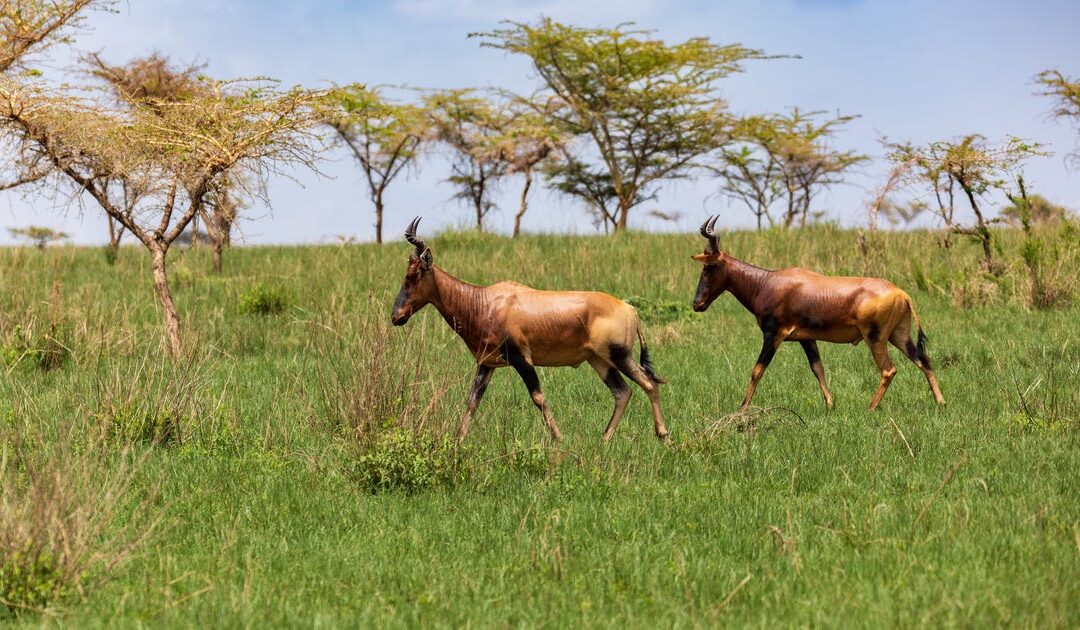
Until surprisingly recently, there were hartebeest in Israel.
Hartebeest are antelope that stand about 1 meter, or 3 feet, tall at the shoulder. In other words, they are not particularly large but they’re large and tasty enough to warrant our culinary attentions. They live in herds that may number dozens to hundreds. We had known they lived here but thought they went extinct in the Iron Age – the biblical era.
Not so, Uri Wolkowski and colleagues reported last week in the Zoological Journal of the Linnean Society.
In prehistory, hartebeest thronged the grasslands and woodlands of Africa and the Levant. In Israel, its remains have been found in archaeological contexts, from the deeply prehistoric starting 260,000 years ago to the Epipaleolithic and Natufian and Neolithic, and through to the Chalcolithic, in biblical-era towns such as Lachish, Ekron and Tel Dor. This has been reported before.

But now it turns out the hartebeest was no stranger to the Negev in the Byzantine and early Islamic periods. That is where it made its last stand about 1,300 years ago.
Hartebeest had even survived the great ungulate extinction in the Iron Age, caused by surging human population growth, which wiped out the very last Israeli aurochs and hippopotamuses.
Yes, Israel had aurochs and hippos too as late as the Iron Age. Anecdotal evidence suggests hartebeests survived in the Egyptian and Judean deserts until the 19th century, when the final large ungulate extinction began, though there is no archaeological corroboration of such late survivors.
So they are gone. The burning question of the day is this: Which hartebeest did Israel have?

This isn’t just a matter of idle curiosity about which variant we propelled into the great void. Hartebeest could be reintroduced for the greater good of both the antelope and ourselves. That makes it pertinent to ask which variant had been here and survived our climate until we ate them, because the one that would do best here is probably the one that did live here.
According to the team, there were two options for the origin of the Israeli hartebeest: the obvious one and the not-impossible one. As for resettlement, there are also two options: the obvious one and the sensible one.
The state of the hartebeest
There is only one species of hartebeest, which emerged in Africa about 4.4 million years ago. In time, the basal group split into northern and southern clades above and below the equator. Then about 400,000 years ago, the northerners cleaved into two populations, northeastern and northwestern.

What have we today? Southern hartebeest, northeastern hartebeest and northwestern hartebeest. Over time, each clade branched further, resulting in altogether eight isolated variants.
Which one spread into the Levant, which happened at least 260,000 years ago? The obvious candidate was the one that had lived along the coast of North Africa and was closest to the Levant: the Bubal hartebeest (Alcelaphus buselaphus buselaphus).
But the northeastern hartebeest Tora (Alcelaphus buselaphus tora) could have plausibly walked up the Nile from Ethiopia and crossed into our region, Wolkowski points out. In the early Holocene, the Sahara and Arabia were not sand-blasted rockscapes but lush lands sprinkled with blessed rain, crossed by rivers and dotted by lakes. The region was paradise (and we may have a vague memory of it), and in short, Wolkowski tells Haaretz by telephone,in the Holocene, hartebeest were found up and down the Nile. Tora could have populated North Africa and the Levant!
But it didn’t, which is a pity. Genetic analysis of hartebeest bones shows that Israel had been populated by the obvious option: the Bubal hartebeest of North Africa. That would make the Bubal hartebeest the obvious candidate for reintroduction to Israel. If it survived here for over 260,000 years until we hunted them into oblivion, theoretically it could do so again. But it’s extinct, and de-extinction is a fantasy.

Ergo, the Bubal hartebeest RIP is neither the obvious option nor the sensible option for resettlement. It is no option at all. So what are the options?
A biblical extinction
There have many great extinctions, of which almost none were our fault because we didn’t exist yet. But research at Tel Aviv University has demonstrated that for all the denial, over the last 1.5 million years human beings drove the giant animals that once thronged Earth to extinction. At the tail end of that sad story, in the Levant, there were two final great ungulate extirpations: in the Iron Age, the biblical era and in the 19th to 20th centuries.
The Iron Age was a time of intense violence and also population growth and migrations. Hartebeest bones identified at Lachish, Gath and other towns associated with biblical lore shows they were there, presumably on a plate.
We add that hartebeest cannot be domesticated, though prehistoric Egyptians tried. But they make terrible farm animals, disliking people intensely and having complex social rules that do not lend itself to fencing in a few and forgetting about it.
They were definitely sacrificed and eaten in Egypt though, which makes one wonder: How actually did the hartebeest out-survive the aurochs and hippo in Israel by thousands of years? Was it smarter and nippier, more able to avoid us apes with spears?
Actually, Wolkowski suspects it was more ecologically versatile. Hartebeests can survive in terrains ranging from wettish savannah to deserts drier than Israel has, which brings us back to why they died out, and potential reintroduction.

We can’t know how versatile the Bubal was because they’re extinct and we can’t see how they behaved, Wolkowski points out. But based on extant variants, hartebeests were probably rare, living in small herds. We created ever-increasing hunting pressure, and as of 10,000 years ago, as we domesticated goats and sheep and cows and later donkeys too, and overgrazed the land, the hartebeest were crowded out. It’s a problem in Africa today no less than hunting pressure, he says.
And as our populations continued to grow, we drove the hartebeest out of green areas to the deserts. Thus we find them in Haluza and Nessana, where the vegetation is sparse and almost as dry as the dust in which it grows. Yet the hardy hartebeest can make do with that, where a gnu wouldn’t have managed.
But when farmers and goats and sheep reached the desert too, and they did, that was the end of the story.
Out of Ethiopia
Why might we want to reintroduce the hartebeest to Israel, not a land known for wide swathes of open terrain just waiting for herbivores? Once there had been an aspiration to restore “biblical animals” to Israel (not lions and leopards) but that agenda seems to have waned.
From the hartebeest’s perspective, it would be good to have another population center, Wolkowski explains. Climate change and ecological damage are advancing apace in Africa. From our perspective, hartebeest can eat things other herbivores can’t, such as desert vegetation. Cows and goats won’t eat thorny bushes. So for us, it would be good to have a (more or less) naturally occurring animal to eat the thorns and with their activity, actually helping to hold back the advancing desert.
But just as not all humans thrive equally well in all climes – we adapt – ditto the hartebeest. Some of the seven extant variants like wetter climes and some do fine in dry. Which of the remaining seven variants do best in the dry conditions that Israel has, and will have?
The closest to the extinct Bubal is the other northeastern subspecies, Alcelaphus buselaphus major. But reintroducing cousin A.b. major to Israel wouldn’t work out because, actually, it’s the variant that likes wet conditions the most, Wolkowski explains. The best candidate is probably the hartebeest that does best in arid conditions, which is the Ethiopian variant Alcelaphus buselaphus Swaynei.

We wouldn’t need to bring hundreds of Swayneis to establish a sustainable breeding population, Wolkowski adds – a small number could do.
The biblical hartebeest
So what have we? The Levantine hartebeest wasn’t done in by the aridification that marked the end of the last Green Sahara episode 7,000 to 6,000 years ago. Optimal habitat had been wider before the Holocene, but even when the Sahara re-emerged there was enough suitable habitat around the Mediterranean Sea biome for the Bubal, the paleontological and ecological models show. Its niche didn’t narrow too much, which led the team to conclude that it wasn’t the climate that caused the decline and fall of the Levantine hartebeest. The habitat here was just fine. We ate his food and ate him too. But if we’re going to bring it back, it might as well being back a more suitable ecological analog and Swaynei fits the bill better than the other hartebeest variants.
It would stand to help Swaynei too. Having been almost wiped out by foot and mouth outbreaks a century ago, they’re also on the road to oblivion, surviving in just two national parks, Wolkowski says. And the desert in Ethiopia where Swaynei thrives is even drier than Israel’s, which could give it more leeway to survive as climate change bites down. Wolkowski adds that the few surviving Swayneis have nice genetic diversity – possibly 10 would be enough to begin a breeding population, and thus we could bring back an animal from the biblical time, even if it wasn’t explicitly mentioned in our sources.
Or maybe it was.
“There are tons of animals mentioned in the Bible that we can’t identify,” points out Hebrew linguistics scholar Elon Gilad. “There are many we identify, but even there it’s because they were identified later, by translators or commentators. In other words, we might think we know what they are but don’t really “know-know” what they are, usually because the descriptions are too short. If the same word is also used in other Semitic languages too, mostly Arabic, that can be helpful. For instance we can be pretty sure that shafan is a hyrax (not hare) because in Arabic, hyrax is thafan.”
Some have suggested that yahmor or maybe teo meant hartebeest but that is very much not the consensus; they are suspected to be oryx and buffalo, respectively, but who knows. So we don’t even know if the Bible refers somewhere to the hartebeest, Gilad sums up. “There is a mysterious animal called zemer …. nobody knows what it might have been – somebody once thought it was a giraffe but it probably wasn’t,” he adds. Maybe that is the elusive biblical hartebeest. But it probably wasn’t.