
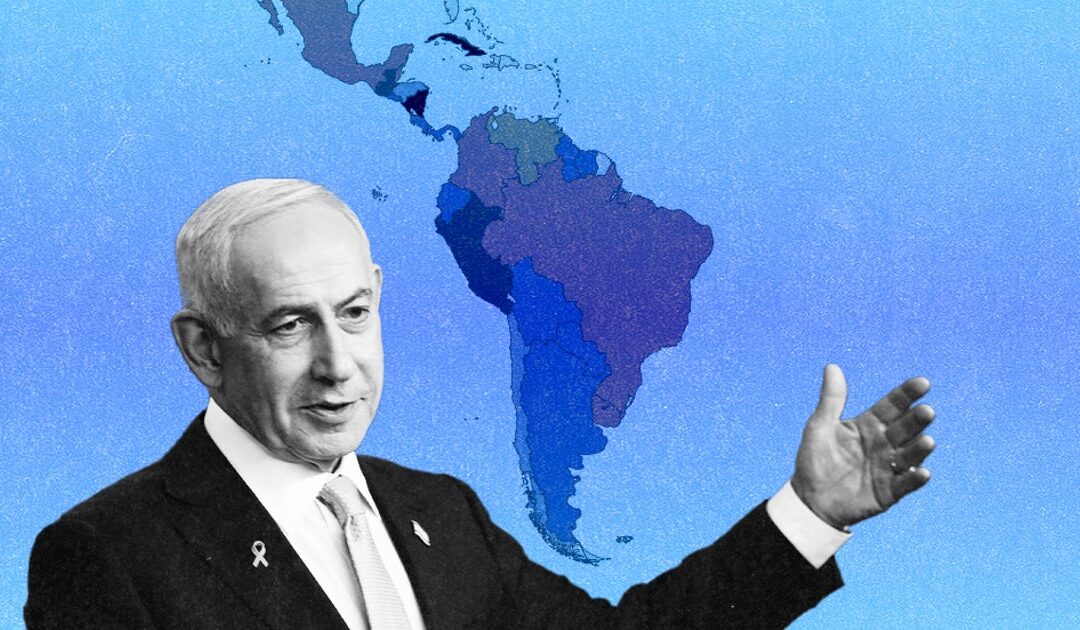
“Something big is happening in Latin America, which I can’t elaborate on here,” Prime Minister Benjamin Netanyahu told his judges last month. His remark came shortly after Raúl Latorre, president of the Chamber of Deputies – the lower house of Paraguay’s Congress – appeared in the courtroom during Netanyahu’s trial and interrupted the proceedings.
Following an angry appeal by MK Gilad Kariv (Democrats) to Paraguay’s ambassador in Israel, the ambassador clarified that his country does not interfere in Israel’s internal affairs and that Latorre had acted solely on his own initiative.
At the time, the incident appeared to be little more than an embarrassing political-diplomatic episode. Less than three weeks later, however, it seems Netanyahu knew what he was talking about. For better or worse, Latin America has indeed been shaken by dramatic developments. With a wave of President Donald Trump’s hand, the U.S. military attacked Venezuela and captured its dictatorial president, Nicolás Maduro.

While it is far too early to know whether the Trump administration has internalized the lessons of Iraq and Afghanistan, or whether the United States is once again embroiling itself in a morally questionable and politically dangerous adventure – one thing is certain: in Israel, across broad swaths of government, the diplomatic corps, and the security establishment, there is deep satisfaction with the turn of events.
At the opening of Sunday’s cabinet meeting, Netanyahu praised Trump for “the decisive action to restore freedom and justice,” adding that “there is a sweeping turnaround in Latin America.” According to Netanyahu, this shift includes the return of several countries “to the American axis and, not surprisingly, also to ties with the State of Israel.”
In recent weeks, Latin America has made global headlines primarily for two reasons: elections in Chile, Bolivia and Honduras that brought right-wing forces favored by Trump to power, and the US president’s increasingly aggressive intervention in the continent’s affairs, culminating in the collapse of Maduro’s regime. Trump also intervened bluntly in the Honduran elections, pardoning former president Juan Orlando Hernández – who was convicted of weapons and drug trafficking, the very charges now leveled at Maduro – and publicly backing his party’s right-wing candidate, Nasry Asfura, in the presidential race.
In July, Trump threatened Brazil in an unsuccessful attempt to influence the trial of former president Jair Bolsonaro, who was convicted of attempting a coup and sentenced to 27 years in prison. In early December, Trump sent threatening messages to Colombian President Gustavo Petro, dubbed the country’s “first leftist president” following his 2022 election. At a press conference after Maduro’s arrest, Trump repeated his warning, telling Petro to “watch his ass.” As for Mexico’s president, the leftist Claudia Sheinbaum, Trump said just several days ago that she does not truly govern her country, claiming instead that drug cartels hold the real power.


In Israel, these developments are widely viewed as a welcome shift to the right – both because many of the countries targeted by Trump have traditionally opposed Israeli policy, and because of the ideological affinity between Netanyahu’s government and the emerging Latin American right. There is also hope that these governments will help bolster Israel’s legitimacy on the international stage.
However, experts and diplomats caution against excessive optimism, pointing to the familiar “Latin American pendulum” – the region’s tendency to swing from left to right and back again every few years. This raises questions about whether the current moment truly reflects a broad and lasting political realignment, and what Israel actually stands to gain from warming ties with right-wing governments in countries whose political influence is often limited and whose trade with Israel – including defense trade – remains marginal.
“Not a zero-sum game”
Professor Arie Kacowicz of the Department of International Relations at the Hebrew University, an expert on Latin American countries, clarifies that a rightward shift on the continent does not automatically translate into support for Israeli policy.
“It’s true that in recent years, the right and far right in Latin America have tended to support the Israeli government, while more progressive countries have been more hostile,” he says. “But despite our tendency to think that anyone who supports a Palestinian state is anti-Israel, and vice versa, in Latin America it isn’t viewed as a zero-sum game.” He notes that in 1947, 13 Latin American countries supported the UN partition plan, backing both the establishment of a Jewish state in the Land of Israel and a Palestinian state.
Kacowicz also points out that many of the Latin American countries Israel is now working vigorously to persuade to move their embassies to Jerusalem had already done so in the past – until Israel’s 1980 Jerusalem Law, which declared the city unified, and the subsequent UN Security Council resolution determining that the law violated international law.
According to an official Brazilian source, the current alignment was not always so clear-cut. “Until the 1960s, the Latin American left admired Israeli intellectuals. Today, it’s conservatives and the right who admire Israel,” the source says. “Israel will continue to lose prestige and legitimacy if it chooses to deepen ties and identify primarily with the most conservative, far-right, and undemocratic forces on the continent.”
Professor Gerardo Leibner, a historian of Latin America at Tel Aviv University, is careful in distinguishing between the interests of Israel’s government and those of its citizens when it comes to relations with the region. He argues that relying on some of Latin America’s right-wing governments is problematic “both practically, because they are unpredictable, and morally.”
As an example, Leibner points to the enthusiasm in Jerusalem last December following the election of far-right politician José Antonio Kast as president of Chile. Kast is known for his admiration of Augusto Pinochet. His victory came after the previous government, led by leftist Gabriel Boric, recalled Chile’s ambassador from Tel Aviv during the early weeks of the Gaza war. Once again, Israeli Foreign Minister Gideon Sa’ar quickly spoke with the winner – whose father was a member of the Nazi Party – and congratulated him.
When asked whether Kast’s open support for Pinochet posed a problem for official Israel, a political source responded: “Half of Chileans openly support Pinochet. He lost the election 49% to 51%. I don’t know what your image of Pinochet is, but for half of Chileans, who surely aren’t all bad or cruel, he was worthy of continuing to lead Chile.” In fact, Pinochet did not lose an election but a referendum held under international pressure, in which 56% of Chileans voted against the continuation of his rule. The result ended 16 years of dictatorship and paved the way for democratic elections.
Regarding Kast, the political source added that he is accepted by the Jewish community. “He is a friend of Israel, he has expressed himself that way, and we know of no reason to disqualify him as a national leader or from establishing friendly relations with Israel.”

It is possible that President Trump’s heightened attention to Latin America – including the recent publication of the US National Security Strategy, which ranked the Western Hemisphere first and the Middle East near the bottom – led Netanyahu to conclude that Israel, too, should focus more on the continent. However, conversations with experts and diplomats suggest that the government’s interest is far narrower. Given the geographic distance, the relatively modest economic and technological development of most Latin American countries, and their limited trade with Israel, Jerusalem’s primary goals are their votes at the UN and the relocation of their embassies to Jerusalem – a largely symbolic move the government is energetically promoting.
“In the past year or two, there’s been positive development in several key Latin American countries, and you can see it reflected in UN votes as well,” a Foreign Ministry source told Haaretz, citing in particular the rise of populist Javier Milei in Argentina two years ago. “He declared he would move the embassy to Jerusalem and supports Israel unequivocally,” the source said.
The eccentric Argentine president has indeed promised to move his country’s embassy to Jerusalem and even announced he would do so in 2026. About two months ago, Sa’ar visited Argentina and expressed hope that Milei would come to Israel in April or May to inaugurate the move, but Argentina has yet to set a date. Meanwhile, Israel decided to subsidize direct flights between Israel and Buenos Aires for the next three years, at a cost of 20 million shekels annually – a decision whose economic impracticality underscores the government’s determination to warm the relations.

In Paraguay – one of Latin America’s most corrupt countries – as well as impoverished Bolivia, which renewed relations with Israel last month after center-right candidate Rodrigo Paz won the election, and tiny, impoverished Honduras, where a Trump-backed candidate won last week by a margin of just 0.8%, the tangible gains for Israel are minimal.
However, with Israel’s international standing so low, it seems the government is willing to scrap even the most negligible support. Sa’ar made a point of publicly announcing that he personally called to congratulate each of the newly elected right-wing leaders, emphasizing each time that he was among the first to do so.
There is also the Iranian issue. Even if Jerusalem hoped for regime change in hostile Venezuela and its replacement by a government based on opposition forces – believed to be much friendlier to Israel – few expected Trump to decide to “run” the country himself for an indefinite period. It remains unclear who will actually govern Venezuela in the near future, and how, but one thing is considered certain in official Israel: with a high degree of probability, Iran’s Revolutionary Guard Corps will lose its ability to use Venezuela as a gateway to the continent, and Hezbollah is also expected to see its grip on the country weakened.

The U.S. takeover of Venezuela is a strategic blow to the ayatollahs’ regime, a close ally of Maduro’s government. According to Danny Citrinowicz, a senior researcher in the Iran and Shiite Axis Program at the Institute for National Security Studies (INSS), Iran is now facing a major challenge in Latin America.
“It’s not that they’ll abandon the continent,” he says, “mainly because of the Shiite communities there,” which are concentrated in Brazil, Argentina and Colombia. According to Citrinowicz, Iran is expected to try to deepen its ties with Nicaragua – a dictatorship that defines itself as a socialist regime opposed to the U.S. – as well as with Cuba. He adds a caveat, noting that “the dream of U.S. Secretary of State Marco Rubio is to change the regime in Cuba,” and that elections are expected soon in Colombia. It appears, then, that Iran’s grip on the continent is likely to weaken significantly in any case, regardless of developments in the Middle East – good news from Israel’s perspective.
From stable to shaky relations
Still, Trump’s aggressive signals to Latin American countries to fall in line with his wishes do not guarantee that they will do so, nor that their attitude toward Israel will align with his expectations. Among Argentina, Bolivia, Paraguay, Honduras and others, Brazil stands out above all – the continent’s largest, most powerful, and by far wealthiest country – where diplomatic relations with Israel deteriorated during the Gaza war to the point of an official downgrading of ties.
First, President Lula da Silva, previously regarded as a friend of Israel, compared Israel’s actions in Gaza to the murder of Jews in the Holocaust by Hitler. In response, Israel declared him persona non grata, and then–Foreign Minister Israel Katz summoned the Brazilian ambassador to Yad Vashem, where he publicly rebuked him. “It was a grotesque, media-driven initiative, unbefitting any diplomatic ethics or practice,” said the official Brazilian source.
Danny Zonshine, Israel’s last ambassador to Brazil, did complete his term despite calls from Brazil’s left to expel him, the source said, but his intended replacement has not received Brazil’s approval. “That’s much more polite and professional than humiliating the sitting ambassador, as Israel did,” the source emphasized. Last September, Brazil officially joined South Africa’s lawsuit against Israel at the International Court of Justice in The Hague.

Mexico, Latin America’s second-largest economy, joined South Africa’s lawsuit as early as May 2024. Claudia Sheinbaum, Mexico’s Jewish president, who won the election a month later, refrained for months from issuing harsh statements about Israel – until last September, when she joined other leaders in describing Israel’s actions in Gaza as genocide.
Another country Israel cannot boast of support from is Colombia, with which it actually had significant cooperation for decades, including arms sales during the long and bloody civil war between the pro-American government and leftist guerrilla groups, chiefly FARC. “For years, there was a strategic triangle – Israel-Colombia-U.S. There was security cooperation, and we relied on coal imports from there,” said the Foreign Ministry source. “That changed with the last election, which brought in a much more problematic, anti-Israel president, and relations were more or less frozen.”
Colombia’s leftist president, Gustavo Petro, is now under intense pressure from Trump and, in any case, will not be able to run in the country’s upcoming May elections due to legal restrictions. But Colombia’s shift away from Israel began even before his rise and prior to the Gaza war. Already in 2020, in an article published in Haaretz, Juan Manuel Santos – the president who signed the peace agreement with FARC in 2016 and proudly referred to his country as “the Israel of Latin America” – wrote that he was deeply concerned by the complete lack of “courage and magnanimity” displayed by Netanyahu’s “hyper-nationalist government.”

According to Professor Leibner, most Central American governments are currently convenient for Israel. “But there’s also Nicaragua, a dictatorship known for its hostility toward Israel; Guatemala, which has no clear direction [its embassy is in Jerusalem and it maintains friendly relations with Israel, but it also recognizes a Palestinian state and has expressed concern about the humanitarian situation in Gaza during the war]; and of course Mexico, which is critical of Israel,” he says, noting that even tiny Belize has asked to join the lawsuit against Israel in The Hague.
In South America, alongside Venezuela and Colombia – both currently opposed to Israeli policy – Leibner also points to Uruguay, governed by a left-leaning coalition that is moderately critical of Israel, “and of course, huge Brazil, where the left currently has the upper hand,” he says. “So yes, there’s now a cluster of rightward and far-right developments that make Netanyahu happy, but overall the trends are mixed. You can’t go out with a headline like the one Netanyahu used.”
Professor Kacowicz says that the election results in Chile, Bolivia and Honduras, along with Trump’s forceful moves against Venezuela and his threats toward Colombia, may indeed signal the beginning of a rightward turn in Latin America. However, he stresses, the trend is far from absolute.
“It could happen in the 2026 elections in Brazil and Colombia, and we’ve seen that Milei did much better than expected in Argentina’s midterms,” he says. “Is it related to Trump? That’s part of it, but not all. Just as 20 years ago there was a Pink Tide in Latin America [a wave of leftward movement, albeit a softer left than communism], it seems there’s now a gray trend toward the right. But it’s not absolute. It doesn’t mean all the countries on the continent will become right-wing.”