
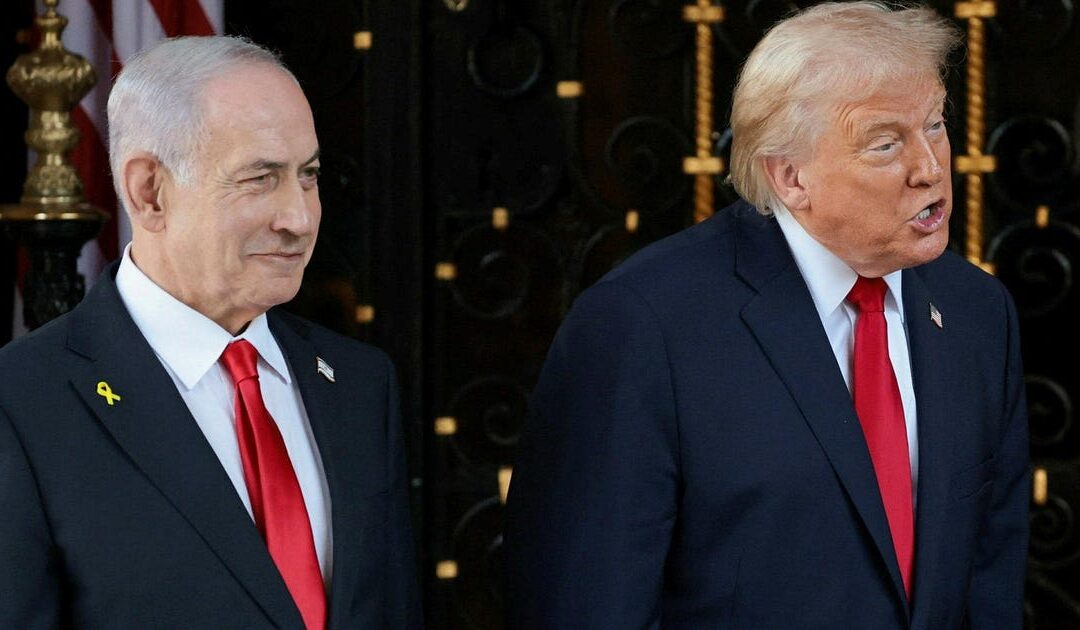
Prime Minister Benjamin Netanyahu said he aims to “taper off” the $3.8 billion in American military aid to Israel to zero within the next ten years, in an interview with The Economist published Friday.
Speaking with the Economist’s Editor-in-Chief Zanny Minton Beddoes, the prime minister said that during his most recent visit to the United States earlier this month, he told President Donald Trump that Israel “very deeply [appreciates] the military aid that America has given us over the years. But here too, we’ve come of age, and we’ve developed incredible capacities in our economy, which will soon, certainly within a decade, reach about a trillion dollars.”
“That’s not saying that I don’t want to fight for the allegiance and support of the American people. I do. You’d have to be crazy not to,” he added.
Haaretz Weekly
How will the Iran protests end? Arash Azizi says ‘This won’t be a classic revolution’
Haaretz Weekly
How will the Iran protests end? Arash Azizi says ‘This won’t be a classic revolution’
total— : —
Netanyahu had previously addressed Israel’s longstanding reliance on American security assistance during a security cabinet meeting in March, saying, “We receive close to $4 billion for weapons. I think we’ll reach a point where we wean ourselves off it, just as we weaned ourselves off economic aid.”
Under the current U.S.-Israel Memorandum of Understanding, American military aid is $3.8 billion annually, about 15% of Israel’s defense budget, through 2028.
In the first two years of the war, the United States has provided Israel with roughly $32 billion in direct military aid. In the first year, under U.S. President Joe Biden, emergency support accounted for about $23 billion, covering an estimated 70% of Israel’s war-related military spending. In the second year, mostly under President Trump, aid totaled $3.8 billion, the annual amount pledged under the agreement.
Netanyahu also reiterated his stance on Iran during his interview, voicing support for the economic protests that have spread across the country, while denying the need for Israeli intervention – and neither condemning nor condoning Trump’s threats to the Iranian regime if it killed demonstrators.
“It may be a moment where the people of Iran take charge of their own destiny,” he said. “Revolutions are best done from within.”

He clarified that “if Iran attacks us, which they might, then there will be horrible consequences for Iran. That’s definite. Everything else, I think we should see what is happening inside Iran.”
When asked about the U.S. president’s stance on events in the West Bank and rising settler violence, Netanyahu declined to answer, saying that Trump had previously been willing to consider annexation. He also said he expects an expansion of the Abraham Accords, claiming that Arab leaders do not care about the Palestinian issue itself, only about its impact on public opinion.
“In private conversations, you want the truth? I mean, beyond the regular things? Many of them don’t give a hoot,” he said. “They don’t care about the Palestinian issue. They care about its effect on the street.”